
FREEBLOCK / TRADING BOTS
Crypto arbitrage
bot development
Develop a trading bot for your arbitrage strategy, from quotes to execution and reconciliation. Account for fees, market depth, latency and venue balances.
Custom development and strategy testing. Trading returns are not guaranteed.

01 / PRODUCT CAPABILITIES
A signal is only the start
A working bot must assess execution feasibility and handle partial outcomes. Price comparison is only one part of the system.

Opportunity calculation
Compare order books or quotes, fees, size and available balances. Distinguish a visible spread from an estimated trade result.

Execution and limits
Set position size, venue limits and partial-fill handling. Include manual and automatic stop controls.

Strategy validation
Test with data, simulation or available test environments. Compare expected and observed execution conditions.
02 / DELIVERY SCOPE
A bot for a defined strategy
Start with signals and entry conditions. Define venues, assets, limits and launch criteria before implementation.
-
Strategy specification
Define entry, exit, fees, balances and allowed deviations.
-
Data and connectors
Connect APIs, quote streams, orders and statuses with rate-limit handling.
-
Execution engine
Implement sequencing, duplicate prevention and recovery after failures.
-
Monitoring and handover
Add logs, alerts, health checks and operating instructions.
03 / ARCHITECTURE
What changes arbitrage complexity
- CEX–CEX, DEX–DEX or mixed
- Pricing and execution differ by venue. On-chain trades also involve gas, confirmations and execution competition.
- Balances and transfers
- Define whether funds are pre-positioned. Transfers between venues have their own timing, fees and limits.
- Account permissions
- Use only necessary API permissions and restrict secret access. A trading connector normally does not need withdrawal access.
04 / FREEBLOCK EXPERIENCE
Real projects behind the work
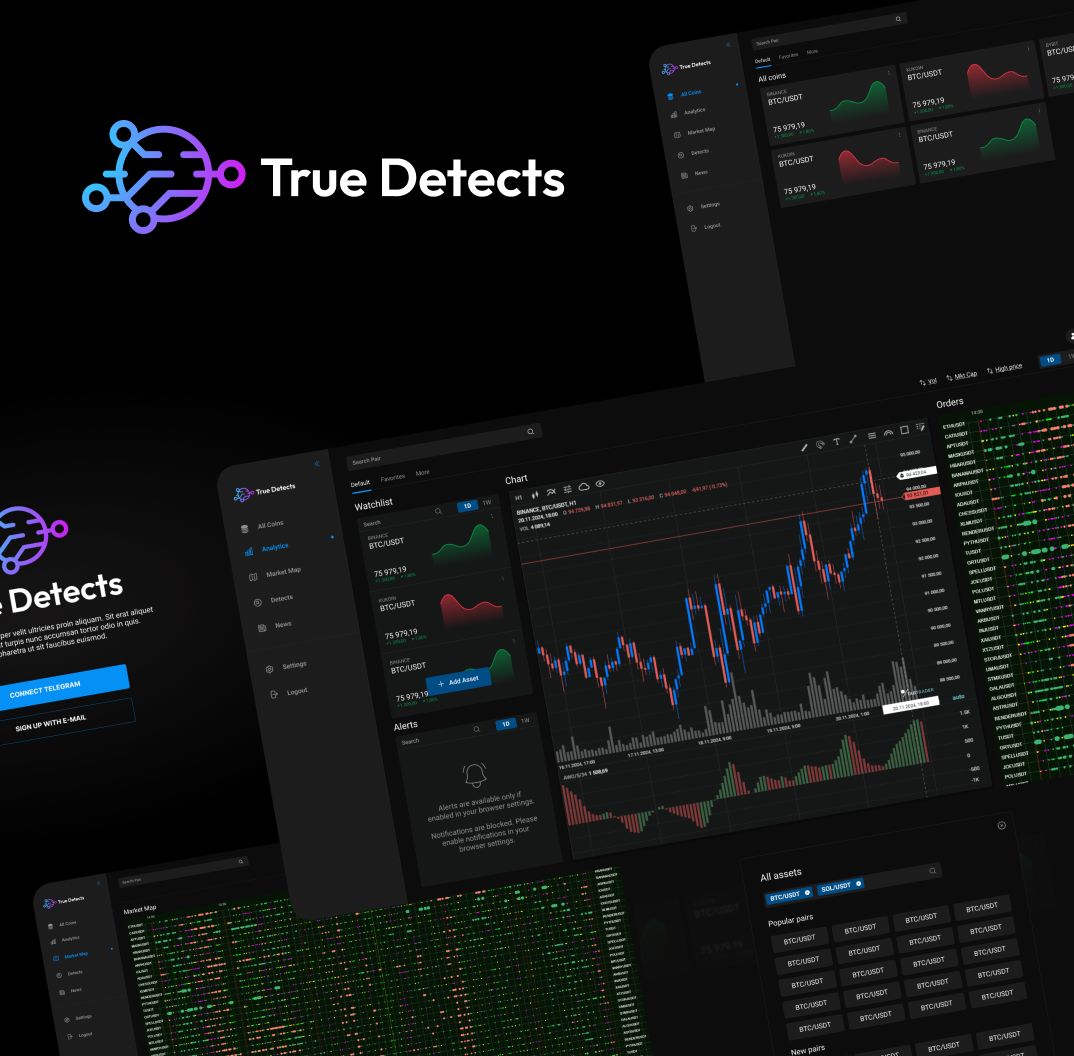
True Detects is our market-analysis and trading interface project, including market data, an order book and trader screens. This is relevant platform experience; automated execution logic is designed and tested separately.
FREEBLOCK / CASE STUDY
True Detects
Front-End for an Analytical Trading Service
ChallengeThe main task is to move away from the limitations of current solutions, optimize data loading, and implement custom graphical components.
What we builtLogin and registration screen. Pair catalog with price cards, 24h change, and mini charts. Default, Favorites, and More tabs with favorites management. Search and modal for adding an asset. Filters by volume, market cap, price, and timeframe. List of popular and new pairs with quick save. Pair details with an interactive…
View case study: True Detects05 / QUALITY AND LAUNCH
Test failure modes before going live
A price gap does not guarantee profit. Fees, slippage, latency and liquidity changes affect outcomes. Start with a testable model and a controlled rollout.
- Stale quotes, disconnects and API rate limits.
- Partial fills, cancellation and duplicate responses.
- Insufficient balances and limit violations.
- Restarting with open orders and positions.
06 / COST AND TIMING
An estimate for your scope
First we define the initial release and its dependencies. Then we estimate the delivery phases and identify external costs separately.
Strategy
Signal, route and execution-rule complexity.
Venues
Exchanges, networks, APIs and market-data sources.
Testing and operations
Simulation, monitoring, infrastructure and support.
07 / TECHNOLOGY
A stack for your product
Tools are selected for your requirements. Logos and links come from our technology catalogue.
Technologies
Blockchains
08 / FAQ
Before we start
Do you sell a ready-made profitable bot?
We develop software for an agreed strategy. We do not promise returns or manage client funds.
Can we start without live trades?
Yes. Begin with data collection and signal checks, then simulate execution. Live trading can be enabled in a separate phase.
Can you integrate CEXs and DEXs?
Yes. Select venues and networks for the strategy. Before estimating, we review APIs, limits, operations and test-environment availability.
What happens after a partial fill?
The specification defines retries, cancellation, hedging or stopping. The right policy depends on the strategy.
How do you estimate cost and timing?
After an initial discussion, we agree on the first release, supported networks and integrations. We estimate delivery by phase and list external costs separately, including infrastructure, third-party services and an independent audit if required.
What do we receive after launch?
You receive source code, documentation and deployment instructions within the agreed scope. Support, monitoring and future releases can be included in a separate delivery plan.
FREEBLOCK / LET’S TALK
Which strategy needs automation?
Describe venues, assets and entry/exit rules. Do you have data, a prototype or strategy test results?